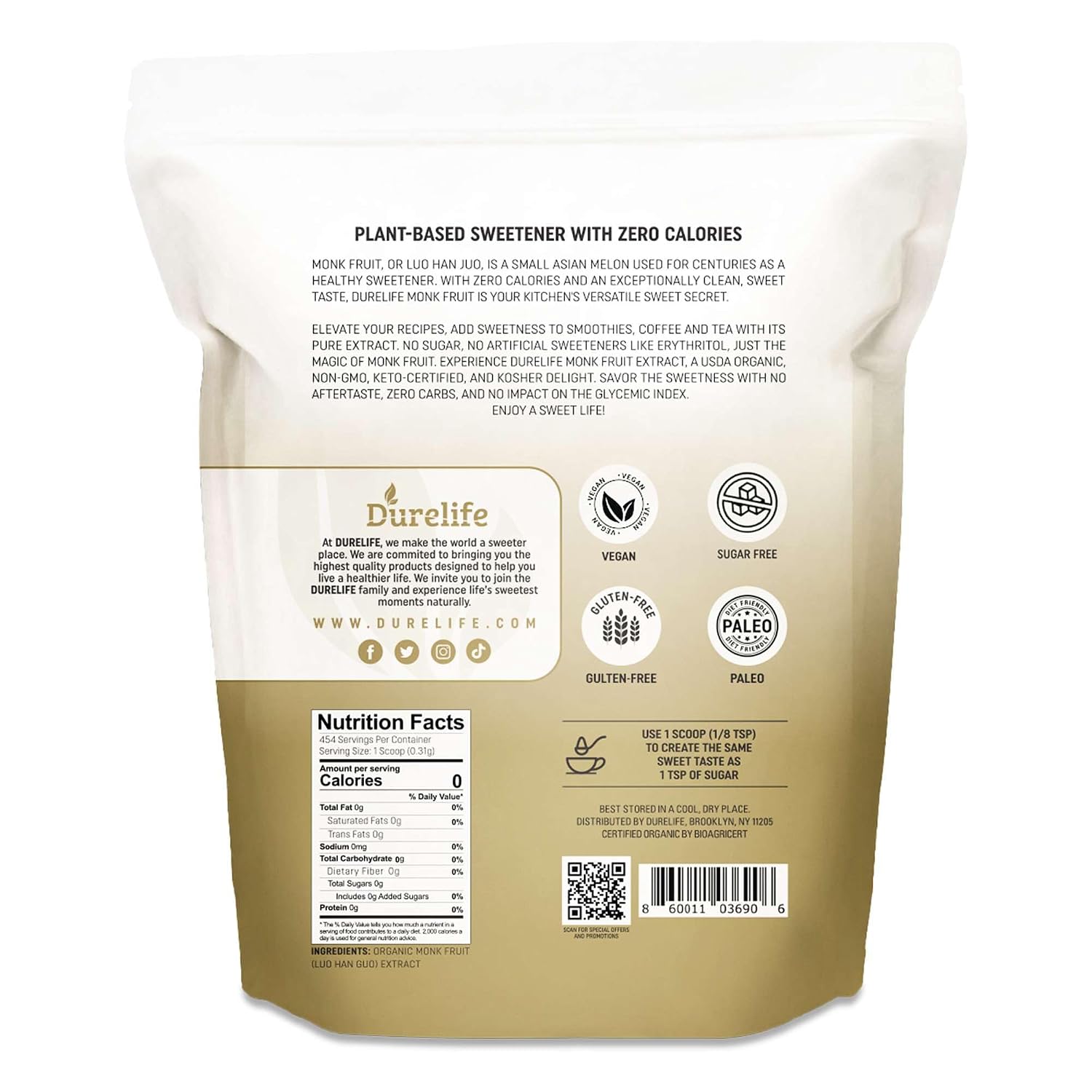
Monk fruit sweetener has become a go-to for anyone trying to cut sugar without the blood-sugar spike that comes with it. But walk down the natural sweetener aisle — or scroll through any supplement retailer — and you’ll quickly notice that most products labeled “monk fruit” are actually blends. The fine print reveals a second ingredient: erythritol (a fermented sugar alcohol used to add bulk and a more sugar-like texture). For many people, that’s fine. But for others — those managing diabetes, following strict elimination diets, or reacting to sugar alcohols — it matters a great deal. This guide breaks down what “pure” monk fruit really means on a label, what the science says about its blood sugar impact, and how to decide whether the premium price of an erythritol-free product is worth it for your specific situation.
Why Most Monk Fruit Products Aren’t Actually “Pure”
Monk fruit extract — derived from the Siraitia grosvenorii fruit grown primarily in southern China — is extraordinarily sweet. The active compounds, called mogrosides (specifically mogroside V), are estimated to be 150–250 times sweeter than table sugar by weight, per Examine.com’s Supplement Reference on monk fruit extract. That’s the good news. The practical challenge is that pure monk fruit extract is so concentrated it’s nearly impossible to measure or use at home in the amounts you’d actually need. A single serving might require a fraction of a teaspoon, which is impractical for most cooking or beverage applications.
Manufacturers solve this with a bulking agent — something to bring the volume up to a 1:1 or near-1:1 sugar substitution ratio. Erythritol is by far the most common choice because it’s also low-glycemic, tastes relatively clean, and has good baking performance. The result is that most “monk fruit” products on store shelves are roughly 95–99% erythritol by weight, with a small percentage of monk fruit extract doing the actual sweetening work.
This isn’t inherently deceptive — the labeling is technically accurate, and for many users, the blend performs beautifully. But if your goal is to consume only monk fruit, the label “monk fruit sweetener” is doing a lot of heavy lifting. The critical read is the ingredient list, not the front-of-pack name.
What to look for on the label
- “Pure monk fruit extract” or “100% monk fruit”: Should list only monk fruit extract (sometimes noted as luo han guo extract or mogroside V) with no secondary bulking agent. These products are typically sold in small dropper bottles or tiny serving-size packets precisely because the extract is so potent.
- “Monk fruit sweetener” or “monk fruit blend”: Almost certainly contains erythritol or, less commonly, inulin, tapioca fiber, or allulose as the bulk filler. Check the ingredient panel.
- “Monk fruit in the raw” or similar grocery-tier branding: These nearly always contain dextrose (a form of glucose) as the carrier — which does have glycemic impact and matters if you’re managing blood sugar closely.
What the Research Actually Says About Blood Sugar Impact
Here’s where the practitioner framing really earns its keep: the glycemic conversation around monk fruit is more nuanced than most marketing suggests.
Pure monk fruit extract: effectively zero glycemic impact. Mogroside V is not absorbed in the small intestine and passes through largely unchanged, so it contributes no glucose to the bloodstream. A 2017 study published in the International Journal of Obesity (Tey SL et al.) compared postprandial (after-meal) glucose and insulin responses across several non-nutritive sweeteners and found monk fruit produced no meaningful spike relative to water controls. Healthline’s nutrition overview on monk fruit sweetener cites consistent findings across multiple small trials. The American Diabetes Association’s 2024 Standards of Medical Care lists monk fruit among nonnutritive sweeteners considered acceptable for people with diabetes when used in place of caloric sweeteners.
Erythritol: mostly benign for blood sugar, but with emerging caveats. Erythritol has a glycemic index of zero and a long track record as a tolerated sweetener in diabetic-friendly products. The blood sugar case against it is limited. However, a 2023 study in Nature Medicine (Witkowski M et al.) generated significant attention by identifying an association between elevated blood erythritol levels and increased cardiovascular event risk — specifically platelet aggregation (clotting tendency). A separate 2023 PNAS study (Nichol AD et al.) found endogenous erythritol (produced naturally in the body through the pentose-phosphate pathway) was associated with adiposity gain in young adults. The critical nuance: these studies identified association, not causation, and much of the elevated erythritol in bloodstreams may be produced internally rather than from dietary intake. Examine.com’s ongoing review notes the research is preliminary and that the levels used in some platelet studies exceeded typical dietary exposure.
The practical verdict for blood sugar specifically: If your primary concern is glycemic control (blood glucose and insulin response), pure monk fruit extract and monk fruit-plus-erythritol blends are effectively equivalent — neither spikes blood sugar. The erythritol question is more relevant if you have cardiovascular risk factors, GI sensitivity to sugar alcohols (erythritol can cause bloating or loose stools in some people at doses above ~50g), or are following a protocol that eliminates all fermented-ingredient inputs.
By the Numbers
| Product Format | Erythritol per tsp | Glycemic Index | Approx. retail cost per oz |
|---|---|---|---|
| Pure monk fruit extract (liquid drops) | 0 g | ~0 | $3–$6/oz |
| Monk fruit + erythritol blend (granular) | ~4 g | ~0 | $0.80–$1.50/oz |
| Monk fruit “in the raw” (dextrose carrier) | 0 g | ~25–30 (dextrose) | $0.50–$0.90/oz |
| Allulose + monk fruit blend | 0 g erythritol | ~0 | $1.20–$2.00/oz |
Retail pricing aggregated from major US natural grocery and supplement retailers as of May 2026. Prices vary by pack size and channel.
The Formats Worth Knowing — and Their Trade-Offs
If you’ve decided erythritol-free is the right call for your situation, you’re not left with one product and no choices. Here’s how the main formats stack up for different use cases.
Pure liquid drops (highest-purity option)
These are the closest thing to “pure monk fruit” in a practical format. Brands including Monk Fruit In The Raw’s liquid line, NOW Foods BetterStevia Monk Fruit, and several craft-wellness labels offer liquid concentrates in 1–2 oz dropper bottles. Owners consistently report excellent results in beverages and yogurt, where a few drops replace several teaspoons of sugar. The limitation is baking: pure extract provides sweetness but no bulk, which affects texture, browning (Maillard reaction and caramelization both require carbohydrate mass), and moisture retention. If you’re baking cookies or cakes, you’ll need to compensate with a separate bulk ingredient — almond flour ratios, egg structure, or a bulking-only fiber addition.
Best for: Beverages, dressings, sauces, no-bake applications. Not ideal for baked goods without recipe reformulation.
Allulose + monk fruit blends (the emerging middle ground)
Allulose is a rare sugar that occurs naturally in small quantities in figs and raisins. It behaves like sugar in the kitchen — it dissolves, browns, and holds moisture — but is metabolized differently, producing almost no glycemic impact (Healthline’s overview of allulose notes it’s absorbed but not converted to energy in the same way as glucose). Blends pairing allulose with monk fruit extract offer a practical erythritol-free alternative with better baking performance than pure drops. Anthony’s Goods and a growing number of specialty brands offer this format. The downside: allulose is more expensive than erythritol to produce, and blends in this category typically run $1.20–$2.00/oz — roughly double a standard monk fruit/erythritol blend. Community feedback in keto and low-GI baking circles consistently notes that allulose-monk fruit blends produce superior browning and fewer crystallization issues post-bake compared to erythritol blends.
Best for: Baking applications where you need sugar-like texture and browning without erythritol or blood sugar impact.
Inulin-based monk fruit blends (niche, worth knowing)
A smaller category uses inulin (a prebiotic fiber derived from chicory root) as the bulking agent. Inulin is essentially zero on the glycemic index, supports gut flora, and avoids the cardiovascular question around erythritol. The trade-off: inulin has a mild earthy or slightly bitter aftertaste that some users find noticeable, and it doesn’t brown or behave like sugar in baking either. GI tolerance can also be an issue at higher doses — inulin is a FODMAP (fermentable carbohydrate) that can cause bloating in sensitive individuals.
Best for: Niche users specifically avoiding erythritol AND allulose who are tolerant of prebiotics and not baking at high volumes.
The Decision Rule: If X, Then Y
You’ve read the trade-offs. Here’s how to translate them into a purchase decision:
If your primary goal is blood sugar control and you cook mostly beverages, sauces, or no-bake applications → pure monk fruit liquid extract is the cleanest, most cost-effective erythritol-free option. Pay for a bottle with a high mogroside V percentage (look for ≥50% mogroside V on the spec sheet or label) to ensure potency and avoid fillers.
If you’re baking regularly and want erythritol-free performance → an allulose + monk fruit blend is the best-documented alternative based on available community and research data. Budget for the price premium; the baking performance justifies it if you’re producing consistent volume.
If you have no specific erythritol sensitivity or cardiovascular concern → the standard monk fruit + erythritol blend (Lakanto, Swerve with monk fruit, etc.) remains an excellent blood-sugar-safe choice, well-supported by years of real-world use and clinical tolerance data. Don’t over-optimize away from a format that works for you based on preliminary research.
If you see “monk fruit” on a grocery-tier packet with dextrose listed in the ingredients → recognize that this product does have glycemic impact (from the dextrose carrier), despite the monk fruit branding. It’s the format most likely to mislead newcomers. Not appropriate for tight blood sugar management.
The label reality is that “pure monk fruit” is a spectrum, not a binary. Once you know what to look for — mogroside V as the active compound, the bulking agent as the variable, and your own use case as the deciding factor — the shopping decision gets significantly clearer. The blood sugar impact of well-formulated monk fruit (with or without erythritol) is minimal; the format you choose is really about how you cook, what your body tolerates, and how much you’re willing to spend.