If you’ve ever baked a keto birthday cake — a sugar-free dessert made without conventional sugar, designed to keep blood glucose (blood sugar) low — and ended up with a weird icy sensation on your tongue, you’ve met erythritol’s notorious cooling effect. Erythritol is a sugar alcohol (a type of sweetener made by fermenting glucose) that’s been the backbone of keto baking for years. It works reasonably well, but its metallic, minty finish and tendency to recrystallize (turn grainy as it cools) have always been its Achilles’ heel. A newer category of blends — combining monk fruit extract with allulose — is fixing exactly those problems, and it’s picking up serious momentum in the low-glycemic baking community. This guide breaks down why those blends behave the way they do, how to compare the main products on the market right now, and how to decide whether switching is worth it for your particular use case.
Why Erythritol Fell Out of Favor (and What the Research Actually Shows)
Erythritol’s reputation took two significant hits in the mid-2020s. First, a 2023 study published in Nature Medicine (reported widely, including in summaries by Healthline and MedicalNewsToday) drew an association between high erythritol blood levels and cardiovascular clotting risk — a finding that was quickly nuanced by researchers who noted that the study measured endogenous (naturally produced in the body) erythritol, not just dietary intake. The full picture is still being worked out. Second, and more practically for bakers: erythritol recrystallizes aggressively. Serious Eats’ overview of sugar substitute baking science notes that recrystallization is the core reason erythritol-based frostings turn sandy overnight and why cookies baked with pure erythritol are often described as “chalky” after they cool.
None of this makes erythritol dangerous at normal dietary doses — the American Diabetes Association’s 2025 Standards of Medical Care still lists sugar alcohols, including erythritol, as acceptable tools for blood glucose management. But it does mean there’s a real functional gap that monk fruit–allulose blends are designed to fill.
Here’s the core trade-off matrix before we go further:
| Property | Erythritol-Based Blends | Monk Fruit + Allulose Blends |
|---|---|---|
| Cooling aftertaste | Noticeable to strong | Minimal to none |
| Recrystallization on cooling | High | Low (allulose stays hygroscopic) |
| Browning (Maillard reaction) | Weak | Moderate–strong (allulose browns) |
| GI impact | ~0 | ~0 |
| Cost per ounce (2026 avg.) | $0.35–$0.55 | $0.55–$0.90 |
| Digestive tolerance | High for most people | High; allulose may cause GI distress at >30g/sitting |
How Monk Fruit and Allulose Complement Each Other
Monk fruit extract (also called luo han guo extract) is intensely sweet — roughly 150–250 times sweeter than sugar by weight, according to Examine.com’s monk fruit research summary — but it contributes essentially zero bulk. On its own, you’d use a fraction of a teaspoon to sweeten an entire batch of cookies, which means the dough structure is completely wrong: no volume, no spread, no caramelization. It’s a flavor ingredient masquerading as a sweetener unless you pair it with something that provides physical bulk.
Allulose is that something. Allulose is a rare sugar (technically a monosaccharide, or single sugar molecule) that occurs naturally in very small amounts in figs, raisins, and wheat. Commercially, it’s produced via enzymatic conversion from fructose. Its key properties, documented in a 2008 study by Iida et al. in the Journal of Nutritional Science and Vitaminology, include near-zero caloric contribution (the body absorbs it but doesn’t metabolize it as an energy source), a glycemic index of essentially zero, and — critically for bakers — it participates in Maillard browning and caramelization reactions the same way sucrose (table sugar) does. Healthline’s overview of allulose confirms that it’s approximately 70% as sweet as sugar by volume, which means it can substitute in a roughly 1:1.3 ratio (use about 1.3 cups allulose where you’d use 1 cup sugar).
When you blend the two, you get:
- Sweetness intensity from the monk fruit extract (so you don’t need as much allulose)
- Bulk, browning, and texture from the allulose
- Zero-to-negligible glycemic impact from both
- No cooling effect — because erythritol isn’t in the picture
The 2017 International Journal of Obesity study by Tey et al. on monk fruit’s postprandial (after-meal) glucose effects confirmed that monk fruit sweeteners did not elevate blood glucose or insulin responses compared to water control, supporting its use in low-glycemic formulation.
Comparing the Main Monk Fruit–Allulose Products (Mid-2026)
The category has gotten crowded fast. Here are the formats and brands most frequently discussed in professional baker forums and low-glycemic nutrition communities, with trade-offs laid out plainly.
Lakanto Golden Monk Fruit Sweetener with Allulose — Lakanto reformulated a portion of their Golden line in late 2024 to incorporate allulose alongside their monk fruit extract, reducing the erythritol load substantially. Reviewers across aggregated purchasing platforms consistently describe the texture in baked goods as “remarkably close to brown sugar,” with appropriate moisture retention in cookies and quick breads. The trade-off: it’s pricier than their original erythritol-based formula, and the allulose content means the sweetener browns aggressively under high heat — useful for cookies, potentially problematic for lightly colored cakes where you don’t want premature browning. Published product specs put the sweetness level at approximately 1:1 sugar equivalence in their blend formulation.
[PRODUCT: Lakanto Golden Monk Fruit Sweetener with Allulose — AFFILIATE_TIER: mid-premium]
Anthony’s Goods Allulose + Monk Fruit Blend — Anthony’s has built a loyal following in the bulk-buyer segment by offering allulose in large-format bags at a cost-per-ounce that undercuts most specialty competitors. Their monk fruit–allulose blend positions itself firmly in the prosumer tier. Reviewers in the keto baking community specifically call out its performance in custards and ice cream bases — allulose’s hygroscopic (moisture-holding) nature prevents the gritty freeze-crystallization that plagues erythritol-based frozen desserts. No cooling aftertaste noted across aggregated reviews. Trade-off: slightly less sweetness intensity than some competing blends, which may require minor recipe adjustment.
[PRODUCT: Anthony’s Goods Erythritol-Free Monk Fruit Allulose Blend — AFFILIATE_TIER: mid-premium]
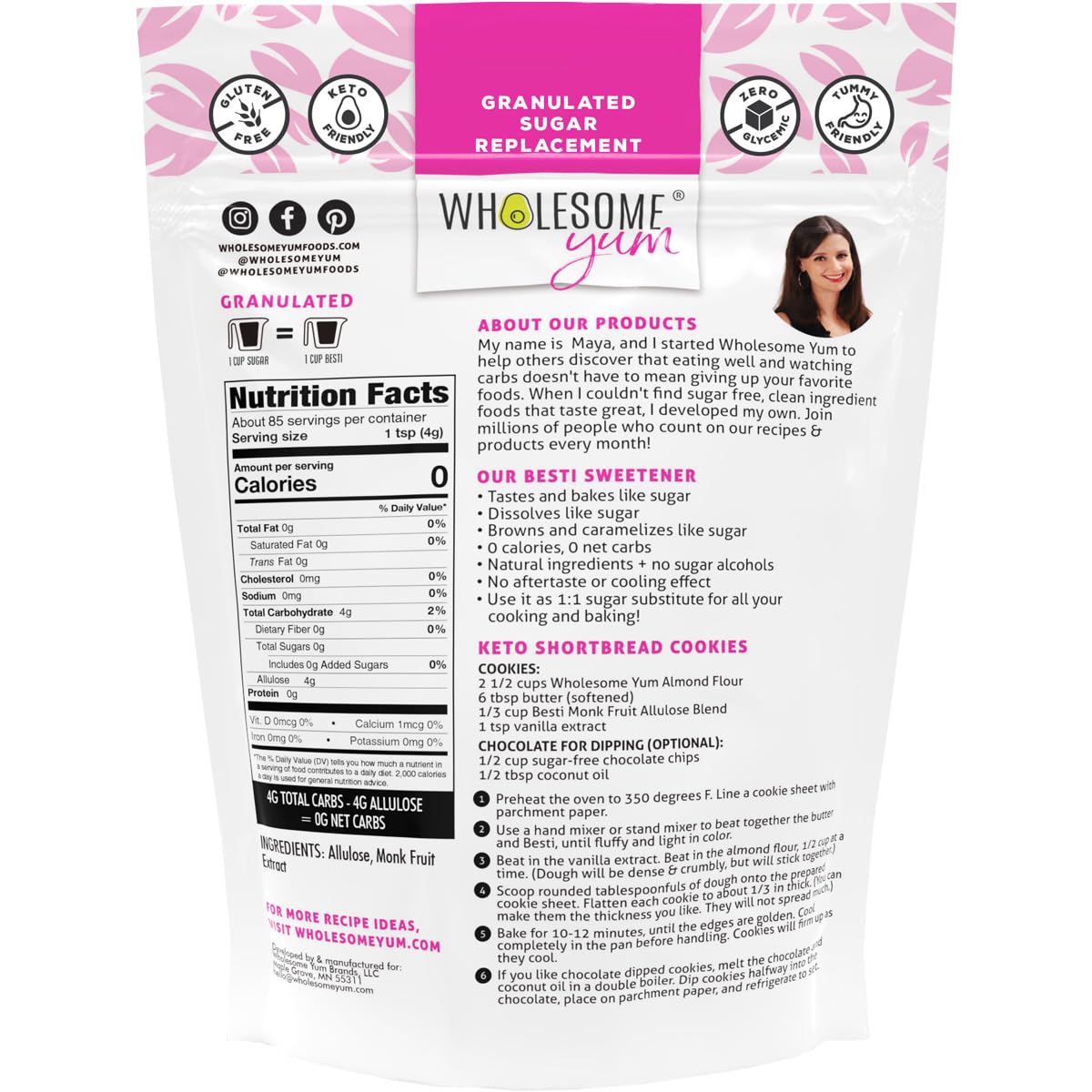
Wholesome Yum Besti Monk Fruit Allulose Blend — This is the product most frequently cited in keto recipe blogs as the “drop-in” erythritol replacement, largely because the brand has published explicit conversion charts and recipe-specific guidance. Reviewers at the confectioner tier note it performs well in buttercreams (frostings) — it doesn’t recrystallize on standing, which is the classic erythritol failure mode. It runs slightly higher in cost per ounce than Anthony’s bulk option. The brand’s published specs indicate a 1:1 sugar replacement ratio, which simplifies recipe conversion significantly.
[PRODUCT: Wholesome Yum Besti Monk Fruit Allulose Blend — AFFILIATE_TIER: mid-premium]
NOW Foods Monk Fruit with Allulose — NOW Foods sits at the accessible end of the monk fruit–allulose category, making it a reasonable entry point for someone testing the format before committing to a larger purchase. It’s available at mainstream grocery at the $15–$22 price point depending on size. Community feedback notes slightly more variation in batch-to-batch sweetness compared to premium-tier options, but for everyday baking and beverage applications it’s considered solid value. Healthline lists NOW Foods as a reputable manufacturer with consistent quality assurance processes in their broader supplement and sweetener coverage.
[PRODUCT: NOW Foods Monk Fruit with Allulose — AFFILIATE_TIER: accessible]
By the Numbers
- Allulose GI: ~0 (vs. sucrose at 65), per Iida et al. 2008
- Monk fruit sweetness potency: 150–250× sugar (Examine.com, 2026)
- Allulose browning threshold: onset at ~280°F / 138°C — roughly 20°F lower than sucrose; worth adjusting oven temp by –25°F when adapting existing recipes
- Cost premium over erythritol-based blends: approximately 40–60% higher per ounce at mid-2026 retail pricing
The Practical Baking Trade-offs You Need to Know Before Switching
If you’re an experienced low-glycemic baker, the performance differences aren’t just marketing language — they show up in specific recipe categories in specific ways.
Where monk fruit–allulose blends win clearly: Anything where erythritol’s recrystallization has historically been a problem. Frosted cakes stored overnight, cheesecakes, ice cream bases, caramels, and any recipe that depends on a moist, fudgy crumb texture. Allulose’s hygroscopic behavior (its tendency to attract and hold water molecules) keeps these applications from turning gritty. Serious Eats’ sugar substitute baking overview specifically identifies moisture retention as the functional gap where allulose outperforms polyols (sugar alcohols like erythritol and xylitol).
Where you need to watch the details: High-heat applications above 350°F. Allulose browns faster than sugar, so blondies, golden cakes, and anything with a delicate color profile will need a 25°F oven reduction and possibly a shorter bake time. This isn’t a dealbreaker — it’s just a variable to manage. Many experienced keto bakers in aggregated review discussions treat the earlier Maillard reaction as a feature (better cookie color at lower heat) once they’ve calibrated their recipes.
The digestive tolerance question: Allulose is generally well-tolerated, but the research and community consensus consistently flags a threshold: at doses above approximately 25–30 grams in a single sitting, some people experience gas, bloating, or loose stools. The American Diabetes Association notes this for allulose in their consumer guidance. If you’re scaling up a recipe for a party or producing a large batch in a small commercial context, do the math on per-serving allulose content before committing.
The cost math: At mid-2026 retail, a 12–16 oz bag of a quality monk fruit–allulose blend runs $18–$28 depending on brand and retailer, versus $12–$18 for a comparable erythritol-based blend. For a home baker making one or two keto treats per week, the premium is essentially invisible on a monthly basis. For a small-batch confectioner running 10+ pound quantities monthly, the 40–60% cost premium is a genuine line item — though several suppliers offer bulk sizing (2–5 lb bags) that narrows the gap meaningfully.
The Decision Rule
Here’s a clean if-then framework based on the research and community pattern:
If you’re currently using an erythritol blend and your primary complaints are cooling aftertaste, recrystallized frosting, or sandy texture in cooled baked goods → switch to a monk fruit–allulose blend, full stop. The functional improvement is well-documented and the glycemic profile is equivalent.
If cost is a primary constraint and you don’t bake frequently → try NOW Foods or a small bag of Anthony’s Goods first. Verify it works in your most-used recipe before buying the larger format.
If you’re a prosumer or small-batch confectioner prioritizing batch-to-batch consistency and clean recipe conversion → Lakanto Golden with Allulose or Wholesome Yum Besti are the community consensus picks, with Lakanto having the longer track record and Besti having the more robust published conversion resources.
If you’re primarily making frozen desserts (ice cream, semifreddo, no-churn recipes) → allulose-forward blends are the right call specifically because of freeze-texture performance. This is where the category truly has no erythritol-based competition.
If you have a confirmed sensitivity to high-allulose doses → portion your recipes carefully and test a single serving before scaling. The 25–30g threshold is real for a subset of people and worth respecting before you serve it to others.
The monk fruit–allulose category is still evolving — new formulations and bulk sizing options are continuing to emerge through 2026. But the core functional case is solid, the price premium over erythritol is narrowing as production scales, and for most keto and low-glycemic bakers who’ve been tolerating erythritol’s limitations, the upgrade is genuinely worth running the math on.