Erythritol is a sugar alcohol — a type of carbohydrate that tastes sweet but isn’t metabolized the way regular sugar is. Unlike sucrose, it provides almost zero calories (roughly 0.2 calories per gram versus sugar’s 4 calories per gram), does not spike blood glucose the way sugar does, and passes through your system largely unabsorbed. That profile has made it one of the most popular natural-origin sweeteners for people managing blood sugar, following a ketogenic diet, or simply trying to reduce added sugar without giving up sweetness. But once you start shopping, you quickly discover it is not a single, uniform product. There is granular erythritol and powdered, corn-derived and non-corn, budget bags and premium bulk formats — and a peculiar icy sensation on the tongue that some people love and others cannot tolerate. This guide breaks down every one of those variables so you can make a confident purchase decision for your specific use case.
Granular vs. Powdered: This Choice Determines Your Application
This is the single most consequential decision at the point of purchase, and it is the one most buyers get wrong the first time.
Granular Erythritol
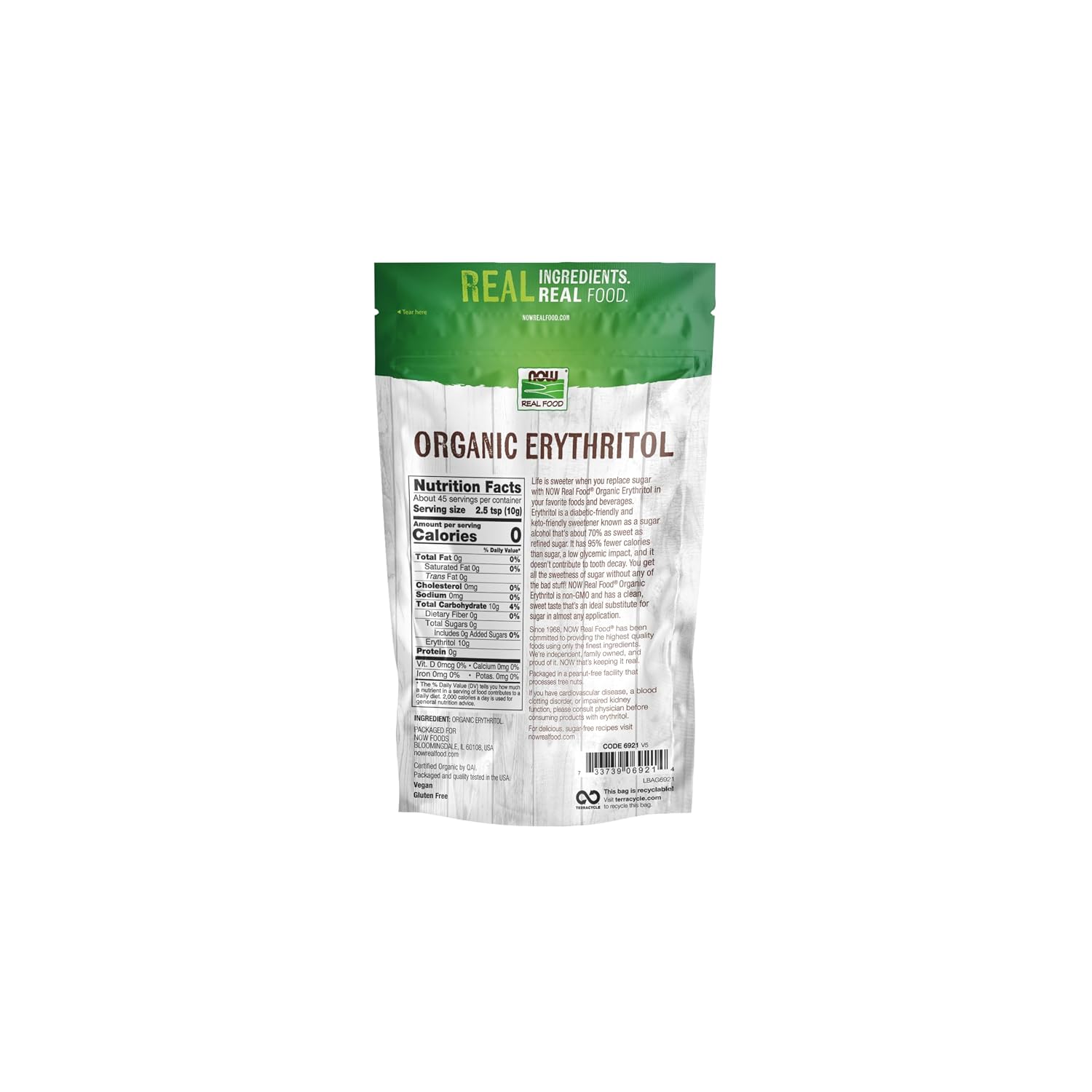
NOW
$7.87
In stock on Amazon
Check price on AmazonGranular erythritol has a crystal structure close to table sugar. The particle size is similar to standard granulated white sugar — coarser than powdered sugar, fine enough to dissolve in liquids with stirring. It performs well in applications where a sugar-like texture is expected: stirred into warm liquid, creamed into butter for cookies, or dissolved into sauces and dressings. Brands such as Anthony’s Goods Erythritol (available in 2.5 lb and 5 lb bags) and NOW Foods Erythritol are predominantly granular formats and represent the best cost-per-gram value in the category for everyday keto baking.
The catch with granular: it does not dissolve well in cold or room-temperature applications, and it can recrystallize after cooling. If you have ever pulled a batch of erythritol-sweetened shortbread out of the oven only to find it sandy or gritty after it cools, you have hit this recrystallization problem. It is not a defect in the product — it is chemistry. Erythritol has a lower solubility than sucrose at room temperature, meaning it tends to return to crystal form as liquid evaporates or temperatures drop.
Best for: Heat-applied baking — cookies, cakes, brownies, caramelized sauces. Also the right starting point for buyers who want to run small batches through a high-powered blender or spice grinder to produce powdered erythritol on demand.
NOW
$7.87
In stock on Amazon
Check price on AmazonPowdered Erythritol
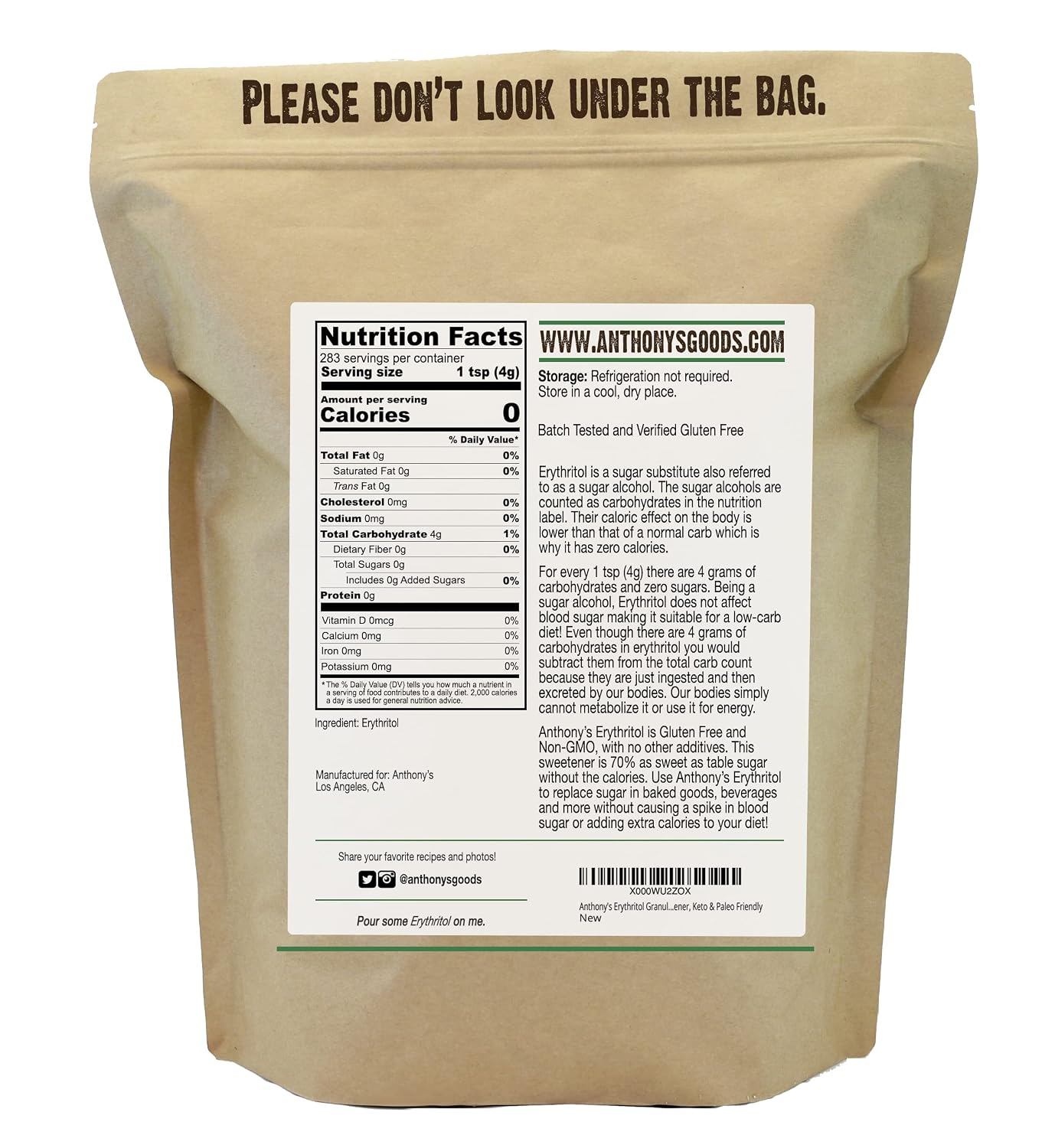
Anthony's
$20.19
In stock on Amazon
Check price on AmazonPowdered erythritol — sometimes labeled “confectioners erythritol” — is the same base molecule ground to a much finer particle size, often with a small amount of tapioca starch added to prevent caking. That fine grind solves the cold-application problem almost entirely: it blends smoothly into frostings, no-bake cheesecakes, whipped cream, chocolate coatings, and cold beverages. Swerve Confectioners is the most widely recognized brand in this category, and it consistently produces a frosting texture close to a traditional powdered-sugar buttercream in cold-application baking. Wholesome Yum Powdered Erythritol is another frequently cited option, particularly for buyers who require non-corn sourcing.
Best for: Cold or no-bake applications — frostings, ganache, cheesecakes, cold drinks, chocolate tempering. In these applications, powdered form is non-negotiable; granular will not produce an equivalent texture regardless of blending effort at the mixing stage.
Anthony's
$20.19
In stock on Amazon
Check price on AmazonBlended and Premium Monk Fruit Formats
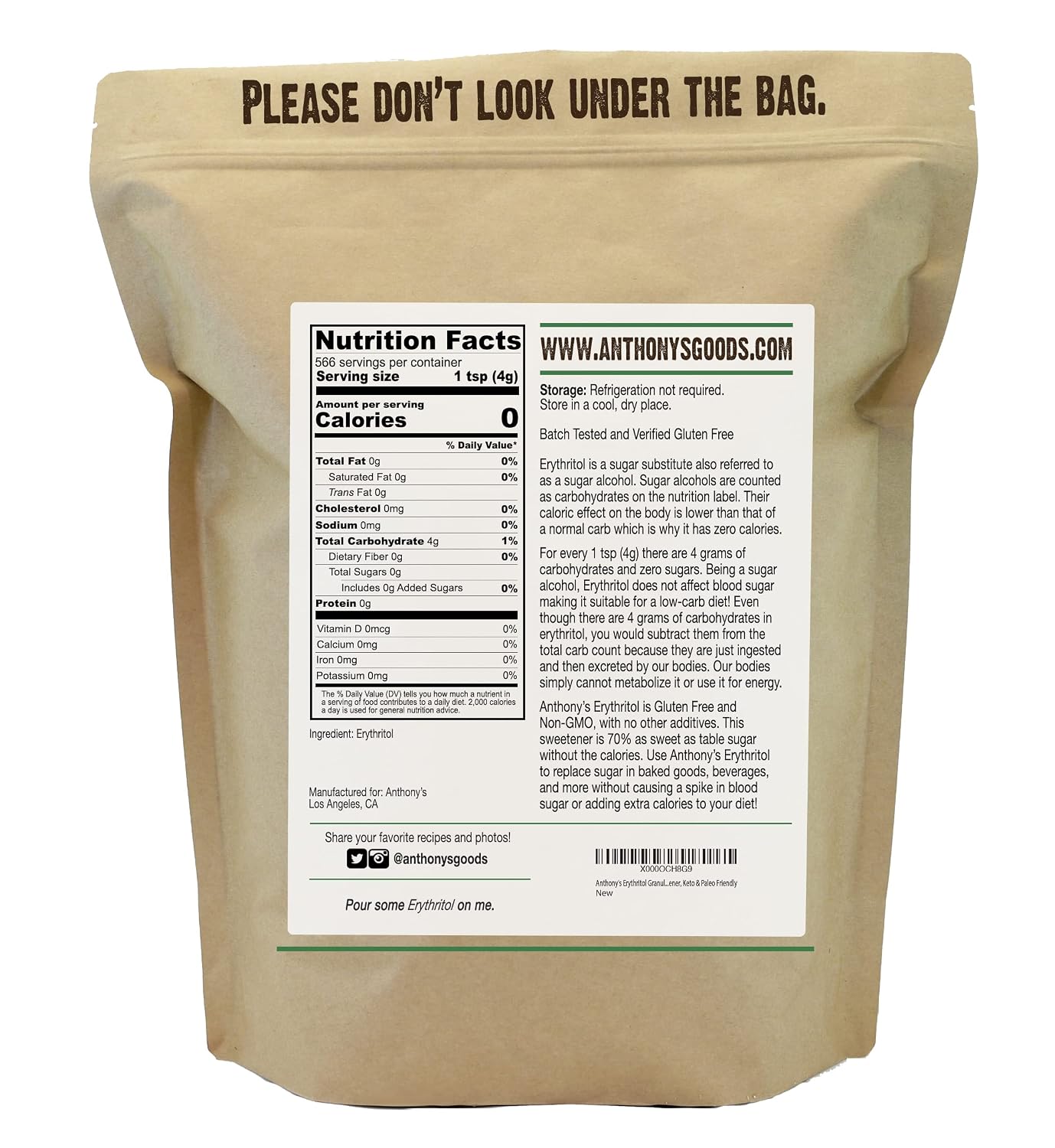
Anthony's
$31.69
In stock on Amazon
Check price on AmazonBlended products — erythritol combined with monk fruit extract, allulose, or inulin — occupy the premium tier and address two limitations of pure erythritol simultaneously: the cooling effect and the lack of browning behavior. Lakanto Granular Monkfruit Sweetener (which pairs erythritol with monk fruit extract) and Lakanto Powdered are the most widely distributed products in this format. Because a smaller absolute quantity of erythritol is needed to reach target sweetness when paired with a high-intensity sweetener like monk fruit, the cooling sensation is typically reduced. Allulose-erythritol co-formulations, increasingly available in 2025–2026 product reformulations, are noted by natural-sweetener formulators as particularly effective at neutralizing the cooling effect while improving browning behavior that pure erythritol lacks.
Best for: Flavor-forward baking, applications where browning matters (blondies, caramel sauces, golden-topped muffins), and buyers for whom the cooling effect has already been a persistent frustration with pure erythritol products.
Anthony's
$31.69
In stock on Amazon
Check price on AmazonCorn vs. Non-Corn: Sourcing, Allergen Risk, and Price Premium
Nearly all commercially produced erythritol reaches consumers via the same basic pathway: glucose is fermented by yeast — typically Moniliella pollinis or similar strains — and the resulting erythritol is crystallized out of the fermentation broth. Per a fermentation process summary published in NutritionJ BioMed Central by Noda et al., the upstream glucose source is where sourcing diverges meaningfully for buyers.
Corn-derived erythritol uses glucose derived from corn starch as its fermentation feedstock. This is the dominant production pathway globally, and it underpins the majority of erythritol sold at accessible price points — roughly $8–$18 per kilogram at retail as of mid-2026. The fermentation process itself destroys the corn protein, which means the final crystallized erythritol contains no measurable corn protein. Per Healthline’s erythritol overview, the product is generally considered safe even for people with corn allergies. However, the “generally” qualifier matters: a small subset of corn-sensitive individuals report reactions, and the regulatory consensus holds that the final product is corn-protein-free, not that it is manufactured in a corn-free facility.
Non-corn erythritol — sometimes labeled as wheat-derived, cassava-derived, or simply “non-GMO non-corn” — uses alternative glucose sources. This category commands a meaningful price premium (typically 30–60% higher per gram) and appeals to three distinct buyer profiles: people with documented corn sensitivity who prefer to avoid all corn-adjacent supply chains; consumers who prioritize non-GMO sourcing on principle; and formulators producing products for corn-allergic end consumers where label claims matter.
A practical note: the non-corn label in U.S. retail is not regulated with the same rigor as, say, a USDA Organic certification. “Non-corn” is a supplier claim, not a third-party verified standard. If your use case requires it — product formulation for corn-allergic consumers, for instance — verify directly with the supplier’s certificate of analysis (COA).
Comparison by format and sourcing:
| Format | Typical retail price (per 500g) | Corn-derived? | Best for |
|---|---|---|---|
| Anthony’s Goods Granular | ~$9–$12 | Yes (non-GMO corn) | Everyday baking, volume use |
| NOW Foods Granular | ~$8–$11 | Yes | Budget workhorse |
| Swerve Confectioners | ~$10–$14 | Yes (oligosaccharide blend) | Cold applications, frostings |
| Wholesome Yum Powdered | ~$11–$15 | Non-corn | Corn-sensitive buyers |
| Lakanto Granular (monk fruit blend) | ~$14–$18 | Yes | Flavor-forward baking |
Prices reflect aggregated retail observations across major U.S. online and natural grocery channels, May 2026.
The Cooling Effect: What It Is, When It Matters, and How to Manage It
The cooling sensation — sometimes called the “cooling effect” or “minty mouthfeel” — is the most divisive functional characteristic of erythritol, and it is the one most buyers either do not anticipate or do not fully understand before purchase.
Here is what is happening chemically: erythritol has a high negative heat of solution. When it dissolves in your mouth, it absorbs heat from oral tissues faster than most other sugars or sweeteners, producing a physical cooling sensation. Examine.com’s erythritol overview and Healthline’s erythritol article both note this as a well-documented sensory property, not an artifact of a specific brand or processing method — it is intrinsic to the molecule.
The cooling effect is application-dependent in its intensity:
- Most pronounced in cold or room-temperature applications where erythritol dissolves slowly on contact with saliva: hard candies, chocolate, cold frostings, no-bake energy balls, and anything where erythritol is the dominant bulk sweetener
- Moderate in cookies, cakes, and muffins where baking disperses the crystals and dilutes the concentration at the palate
- Least noticeable in liquid applications such as syrups, sauces, and warm beverages where erythritol is fully dissolved before consumption
Managing the cooling effect in practice:
-
Blend with a complementary sweetener. The most effective and widely adopted strategy is pairing erythritol with monk fruit extract, allulose, or inulin. Because a smaller absolute quantity of erythritol delivers target sweetness in a blended product, the cooling effect is proportionally reduced. Allulose-erythritol blends are noted by formulators as particularly effective at neutralizing cooling while restoring browning behavior.
-
Use powdered form in chocolate applications. The finer grind distributes erythritol crystals more evenly through a chocolate matrix, which means any given receptor on the palate contacts less concentrated erythritol at once. Serious Eats’ coverage of sugar substitute behavior in confectionery applications notes that crystal size has a measurable effect on perceived mouthfeel in cocoa-butter-based products.
-
Accept it as a feature in specific contexts. Mint-forward recipes, certain chilled desserts, and sparkling-beverage applications can benefit from the cooling effect. Craft beverage formulators occasionally select erythritol specifically for this property in summer drink applications.
If cooling is a hard dealbreaker for your use case, consider whether erythritol is the right primary sweetener at all. Allulose has a near-zero glycemic impact and excellent browning behavior with minimal cooling effect, and it is increasingly competitive on price as domestic U.S. production scales. Pure monk fruit extract in liquid or powder form has no cooling effect. For buyers where the cooling sensation consistently undermines the end product, treating erythritol as a supporting sweetener — at 30–50% of total sweetener volume rather than 100% — tends to resolve the problem without requiring a full reformulation.
Digestive Tolerance: Why Erythritol Outperforms Other Sugar Alcohols
One of erythritol’s genuine differentiators is its digestive tolerance profile relative to other sugar alcohols like maltitol, sorbitol, or xylitol. Per a study published in the American Journal of Clinical Nutrition by Bernt et al. (1996), indexed on NCBI PubMed under record 8933042, approximately 90% of consumed erythritol is absorbed in the small intestine and excreted unchanged in urine. This means very little reaches the large intestine where fermentation by gut bacteria causes the gas and bloating associated with other sugar alcohols. MedicalNewsToday’s erythritol safety article notes that it has the highest gastrointestinal tolerance threshold among commonly used sugar alcohols, with laxative-effect thresholds observed at substantially higher doses than sorbitol or maltitol.
The practical implication for buyers: erythritol is a safer bet for products or recipes that will be consumed in meaningful quantities at one sitting — a full dessert serving, a large batch of candy — where maltitol-sweetened alternatives might cause digestive issues for sensitive individuals.
That said, very high single-dose consumption can still cause mild GI discomfort in some people. Examine.com’s erythritol tolerance data notes that individual variation exists and that effects have been observed at 50 grams or more in a single sitting for sensitive individuals. For most real-world recipe applications, this threshold is not a concern.
Decision Framework: Matching Format to Use Case
You have absorbed the variables. Here is the simplified routing logic:
If you are baking cookies, cakes, or muffins at home and price sensitivity is a factor — Anthony’s Goods or NOW Foods granular erythritol. Run it through a blender for powdered as needed. Best cost-per-gram value in the category.
If you are making frostings, chocolate, or any cold-application confection — Swerve Confectioners or Wholesome Yum Powdered. Do not try to substitute granular. The texture difference is not minor and is not fixable at the mixing stage.
If the cooling effect is already frustrating you in a specific recipe — switch to a blended product such as Lakanto’s monk fruit-erythritol blend or an allulose-erythritol co-formulation, and use it at approximately 70–80% of your original erythritol volume as a starting calibration point.
If you are formulating for corn-sensitive consumers or need non-corn label claims — verify the supply chain directly with the vendor COA before committing. Budget for the 30–60% price premium. Non-corn options are available but require more sourcing legwork than standard retail channels provide.
If you are buying for bulk professional use in 5–25 lb formats — Anthony’s Goods bulk granular or NOW Foods professional packs offer the most defensible cost-per-gram math at current mid-2026 pricing. Confirm batch consistency with a sample order before committing to large quantity.
The erythritol market has matured significantly. This is no longer a product category where all options perform comparably. Matching the format and sourcing to the application is the actual work. The molecule itself is well-validated across the published literature; the buying decision is an execution question.