If you’ve ever swapped regular brown sugar out of a cookie or brownie recipe and ended up with something pale, weirdly grainy, or missing that warm, toffee-like depth — you’re not imagining it. Brown sugar is doing a lot more than adding sweetness: the thin coating of molasses on each crystal gives baked goods their color, chewiness, and that distinctive caramel flavor that most sugar alternatives can’t easily replicate. This article is for bakers and formulators who are past the “just use stevia” stage and want to understand why certain substitutes work — specifically Lakanto Golden (a monk fruit–erythritol blend designed to mimic brown sugar), straight allulose, and allulose-based blends — and where each one falls short. By the end, you’ll have a clear decision rule for your next batch.
What Brown Sugar Is Actually Doing (and Why It’s Hard to Copy)
Before comparing substitutes, it helps to know what you’re replacing. Brown sugar is refined white sugar with molasses added back in — typically 3–5% molasses for light brown, up to 10% for dark brown. That molasses fraction carries three functional roles:
Hygroscopicity (the tendency to absorb and hold moisture from the air and surrounding ingredients): molasses is extremely hygroscopic, which is why brown sugar baked goods stay chewier longer than their white-sugar counterparts.
Maillard browning and caramelization: standard sucrose (table sugar) caramelizes at around 320–340°F. Fructose, which is abundant in molasses, caramelizes at a lower temperature — closer to 230°F — giving brown sugar recipes a faster, deeper color at typical oven temperatures. As Serious Eats’ baking science coverage notes, this early-onset browning is a central reason brown sugar cookies turn golden before they’re dry, producing soft centers.
Flavor complexity: molasses contains organic acids, trace minerals, and compounds like furaneol and maltol that register on the palate as toffee, butterscotch, and slight bitterness. No sugar substitute currently replicates this flavor matrix natively.
The substitutes discussed below each solve part of this problem — and each leaves a piece of it unsolved.
Lakanto Golden: The Closest Structural Match
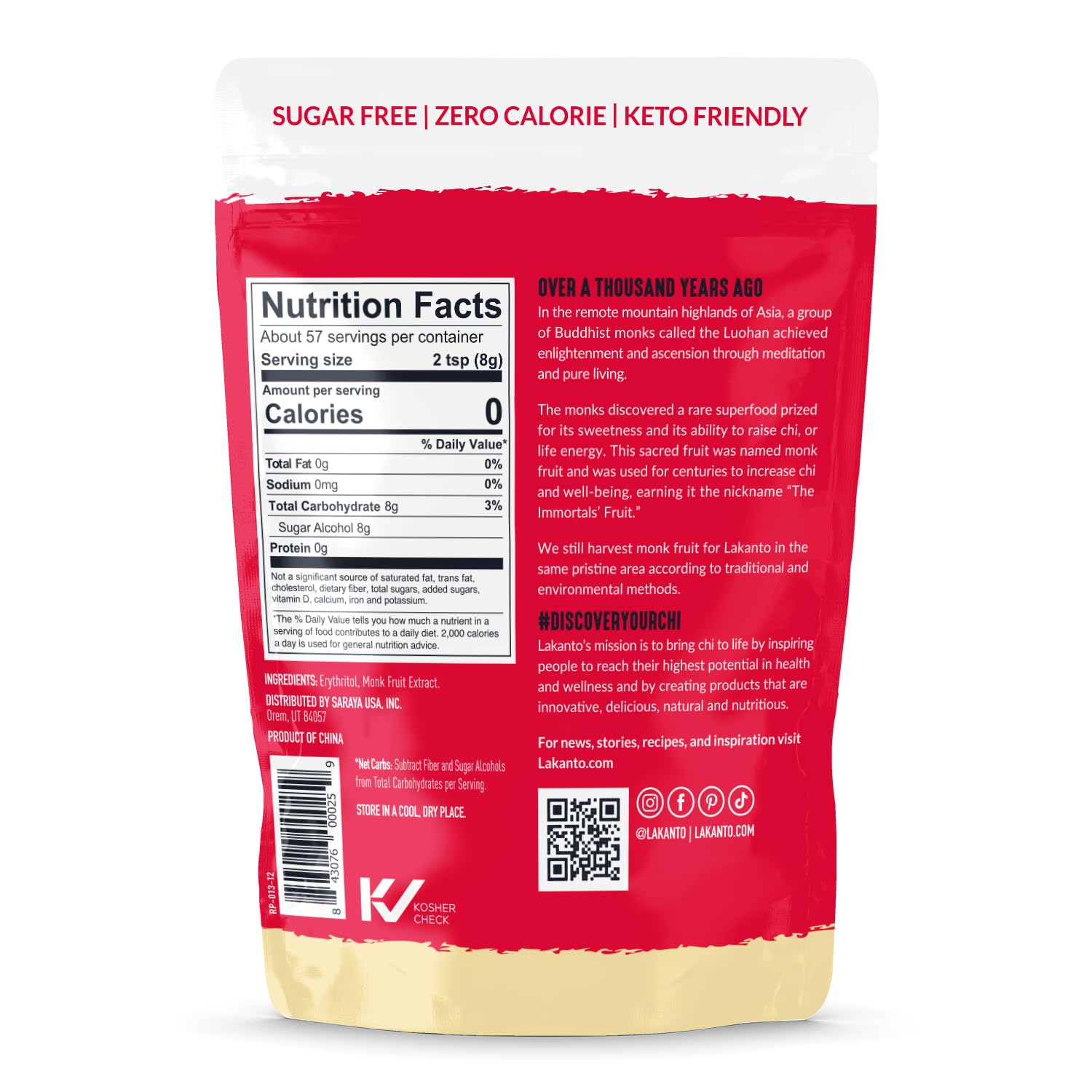
Lakanto Golden is the most purpose-built brown sugar alternative on the mainstream market. It’s a blend of erythritol (a sugar alcohol — fermented from glucose, roughly 70% as sweet as sucrose, nearly zero calories, and glycemic index of zero) and monk fruit extract (luo han guo concentrate, extremely sweet in small quantities, also glycemic index zero). Lakanto adds natural flavors intended to approximate the molasses note, and the product is textured to resemble raw turbinado-style crystals rather than fine white powder.
What it gets right: The coarser crystal size contributes to a similar mouthfeel in shortbread and streusel applications. Erythritol does produce some Maillard browning in the oven, though it requires higher temperatures and longer times than sucrose. Across aggregated baking forums and reviews tracked through mid-2026, home bakers report that Lakanto Golden is the most reliable 1:1 swap in recipes like oatmeal cookies, banana bread, and brown sugar glazes where a deep amber color and gentle sweetness are the goal.
Where it falls short: Erythritol does not caramelize the way sucrose or fructose does. What you get is browning — the Maillard reaction between amino acids and reducing sugars — but not the liquid-stage caramelization that produces praline, brittle, or a sticky toffee sauce. Erythritol also has a well-documented cooling sensation (a slightly minty-cold finish on the palate), which is mild in baked goods but noticeable in raw applications like frosting or no-bake energy bars. Examine.com’s erythritol overview confirms the cooling effect is a recognized sensory artifact, not a sign of a bad batch. The molasses flavor gap is real: the added natural flavors get you closer, but reviewers consistently describe Lakanto Golden as “brown sugar–adjacent” rather than identical — warm, pleasant, but lighter.
Pricing reality (as of May 2026): Lakanto Golden typically runs $0.55–$0.75/oz at major retailers, putting a 16oz bag in the $9–$12 range. Bulk formats (3lb bags) bring that closer to $0.40–$0.50/oz. That’s 3–4x the cost of commodity brown sugar, which matters at production scale.
Allulose and Allulose Blends: The Caramelization Upside
Allulose is where things get genuinely interesting for formulators. It’s a rare sugar — found naturally in tiny amounts in figs, raisins, and jackfruit — that the FDA classifies separately from added sugars because the body doesn’t metabolize it for energy. Healthline’s overview of allulose notes that it provides roughly 0.4 kcal/gram (compared to 4 kcal/gram for sucrose) and has a glycemic index effectively at zero, confirmed by human studies cited in the NCBI / PubMed literature (Granström et al., Food Chemistry, 2023).
Here’s the critical mechanical advantage: allulose caramelizes. Not approximately — it undergoes genuine Maillard browning and caramelization reactions in the same temperature range as fructose (roughly 230–250°F). This means:
- Cookies develop actual golden-brown edges without extended bake times
- Sauces and glazes can reach an amber, pourable-toffee state
- Brittle and hard candy applications are viable — erythritol can’t claim this
The flavor of caramelized allulose is widely described by recipe developers as slightly milder and less bitter than sucrose caramel, without the cooling note of erythritol. Per baking coverage from Bon Appétit, allulose is increasingly the preferred sugar alternative for caramel sauce recipes where texture and color are non-negotiable.
The trade-offs: Allulose is hygroscopic — comparable to brown sugar itself — which means baked goods may have a slightly sticky surface, and it can accelerate browning enough that you’ll want to reduce oven temperature by 10–15°F or shorten bake time when substituting directly. It’s also noticeably expensive: straight allulose powder (brands like Anthony’s Goods or NOW Foods allulose) runs $0.50–$0.80/oz at retail in mid-2026, which approaches the price of Lakanto Golden but with more functional versatility.
Allulose blends — products that combine allulose with erythritol, monk fruit, or fiber — try to balance cost with performance. The erythritol brings sweetness intensity up (allulose is only about 70% as sweet as sucrose) while the allulose carries the caramelization function. The tradeoff is reintroducing some of the cooling note.
The Molasses Flavor Gap: Can You Close It?
This is the question no substitute fully answers, and it’s worth being direct about: none of the mainstream zero-glycemic brown sugar substitutes contain molasses or anything chemically equivalent to it. The flavor gap is real, and acknowledging it is how you make better formulation decisions.
By the numbers:
| Substitute | Caramelizes? | Browning Speed | Molasses Flavor | GI | Approx. Cost/oz (2026) |
|---|---|---|---|---|---|
| Lakanto Golden | Partial (Maillard only) | Slow | Low–medium (natural flavors) | 0 | $0.50–$0.75 |
| Pure allulose | Yes (true caramelization) | Fast (reduce temp) | None | 0 | $0.50–$0.80 |
| Allulose + erythritol blend | Yes (moderate) | Moderate | None to low | 0 | $0.45–$0.70 |
| Yacon syrup | Limited | Moderate | Mild, earthy | ~1 | $0.80–$1.20 |
Practitioners who need that warm, slightly bitter molasses depth have a few workarounds that appear consistently in professional baking literature and specialty food forums:
-
Add a small amount of blackstrap molasses (roughly 1 tsp per cup of substitute). Blackstrap is the most mineral-rich, least sweet molasses fraction — a diabetes.org resource on carbohydrate counting notes it has a relatively lower glycemic impact than light molasses, though it’s not carbohydrate-free. A teaspoon in a full batch adds minimal sugar load but delivers the flavor compounds no substitute can synthesize.
-
Use yacon syrup as a partial substitute. Yacon (derived from the root of a South American plant) is naturally sweet from fructooligosaccharides (prebiotic fibers that aren’t fully digested) and carries a mild, dark, almost fig-like sweetness that reads closer to molasses than most alternatives. It behaves as a liquid, so it requires recipe adjustment, but craft bakers report it as the most “honest” brown sugar flavor analog available at specialty retail.
-
Lean into complementary flavor additions — a pinch of cinnamon, a drop of vanilla extract, or a small amount of date paste can shift the flavor profile toward the warmth that molasses typically provides.
Decision Rules: If X, Then Y
You’ve read the trade-off matrix. Here’s how to act on it:
If your priority is a clean 1:1 swap for everyday baking (cookies, quick breads, oatmeal): Lakanto Golden is the most forgiving starting point. Expect slightly less browning, no caramelization, and a mild cooling finish in raw applications. Adjust expectations accordingly; don’t adjust the recipe much.
If caramelization and browning are non-negotiable (caramel sauce, toffee, pralines, glazed applications): Use straight allulose or a predominantly allulose blend. Reduce oven temperature by 10–15°F relative to your standard recipe. Accept that the molasses flavor won’t be there unless you add blackstrap or yacon.
If you’re formulating for diabetic or strict keto consumers and molasses flavor matters: The most honest solution is allulose base + 1 tsp blackstrap per cup of substitute — this keeps the glycemic load low while restoring the flavor signature. Disclose the trace molasses to your audience; it matters for those managing blood sugar carefully, and diabetes.org guidance consistently emphasizes transparency in carbohydrate sources.
If you’re working at production scale and cost is a constraint: Allulose blends (allulose + erythritol + monk fruit) generally offer the best cost-performance ratio for caramelization-sensitive applications, coming in slightly below pure allulose. Lakanto Golden’s brand recognition earns a price premium that may not be justified in formulations where the product is an ingredient rather than a retail-facing SKU.
If flavor authenticity is the only metric: Yacon syrup deserves a serious trial run. It’s more expensive, requires liquid-to-solid ratio adjustments, and has shorter shelf stability — but for small-batch artisan products where the ingredient story matters to the consumer, it closes the molasses gap more honestly than any synthetic flavor addition.
The bottom line is that no single substitute wins on every dimension. Allulose earns the edge on function; Lakanto Golden earns the edge on convenience; yacon earns the edge on flavor fidelity. Knowing which dimension your recipe optimizes for is the decision, and now you have the framework to make it cleanly.