If you’ve ever swapped allulose (a naturally occurring rare sugar that tastes almost identical to table sugar but contributes virtually zero usable calories) into a baking recipe and pulled charred cookies out of the oven ten minutes early, you’ve already met the problem this article is here to solve. Allulose has had a remarkable run in the natural-sweetener aisle — it’s become a go-to for keto and diabetic bakers because it doesn’t spike blood glucose the way regular sugar does, per Healthline’s overview of allulose. But the brands selling it, even the premium ones, tend to bury or skip one very important fact: allulose undergoes the Maillard reaction (the chemical process that browns and crisps baked goods) and caramelization at significantly lower temperatures than sucrose does. That gap between what the package implies and what actually happens in a 350°F oven is costing bakers batches, recipes, and money. Here’s everything you need to know before your next bake.
Why Allulose Browns So Much Faster Than Sugar
To understand the browning problem, a quick chemistry orientation is useful. Regular table sugar (sucrose) caramelizes around 320–375°F depending on purity and moisture. The Maillard reaction — a separate but related process between sugars and amino acids that produces golden-brown color and toasty flavor — kicks in around 280–330°F for sucrose in typical dough or batter.
Allulose is a monosaccharide (a single sugar molecule), not a disaccharide like sucrose. That structural difference matters enormously. Monosaccharides participate in Maillard browning more readily because they have a free reactive end that disaccharides lack until they’re broken apart. As reported in research covered by NCBI/NLM peer-reviewed literature on allulose’s functional properties, allulose begins meaningful Maillard activity at temperatures roughly 20–30°F lower than sucrose — and caramelization onset can be even more aggressive.
What this means in practice: a cookie formula calibrated for sucrose at 350°F for 12 minutes may deliver over-browned, bitter-edged results with allulose at the same time and temperature. The exterior achieves the visual cue of “done” while the interior is still structurally weak, leading to the notorious allulose problem of cookies that look baked but collapse or feel gummy on cooling.
Serious Eats’ foundational piece on sugar chemistry in baking reinforces this mechanism — monosaccharides and invert sugars (honey, agave) have long been flagged by recipe developers as requiring temperature or time adjustments for exactly this reason. Allulose sits in the same chemical category, but its marketing rarely reflects this.
The Real Adjustment Protocol: Temperature, Time, and Pan Variables
If you’re formulating or adapting recipes with allulose, the single biggest lever is oven temperature reduction — not a minor tweak. Community formulators and professional bakers who’ve published documented results (compiled across forums, food-science publications, and aggregated review threads) consistently land on a 25–50°F reduction as a starting baseline, with bake time often extended by 10–20% to compensate for the lower driving heat.
By the numbers:
| Variable | Sucrose baseline | Allulose adjustment |
|---|---|---|
| Oven temp (cookies) | 350°F | 300–325°F |
| Bake time extension | — | +10–20% |
| Browning onset temp | ~280–330°F | ~250–300°F |
| Caramelization onset | ~320–375°F | ~280–340°F |
These ranges aren’t universal laws — they shift with fat content, hydration, protein percentage, and pan material. Dark metal pans accelerate surface browning further and may require an additional 10–15°F reduction or parchment shielding. Silicone mats attenuate the effect somewhat. Glass or ceramic bakeware moderates bottom browning but the surface still responds to ambient oven heat.
For cakes and quick breads, the adjustment is subtler because higher moisture content buffers surface temperature. A standard 350°F pound cake formula might only need a 325°F allulose adaptation — but watch the toothpick test, not the color cue. That golden-brown crust you’d normally read as “done” can appear 8–10 minutes before the crumb is fully set.
For caramel and confectionery work, the implications are more serious. Allulose caramel (increasingly popular in keto candy formulation) is genuinely workable, but the working window — the temperature range between “golden caramel” and “burnt, bitter mess” — is compressed. Candy thermometers and active temperature management are non-negotiable. MindBodyGreen’s coverage of allulose notes its functional culinary versatility, but experienced confectioners consistently flag that it demands closer monitoring than sucrose caramel work.
Aftertaste and Texture: What Browning Chemistry Changes
Here’s the trade-off most buying guides don’t name clearly: browning chemistry doesn’t just affect color — it generates flavor compounds. With sucrose, the Maillard reaction produces furans, pyrazines, and other aromatic compounds that contribute to what we perceive as “bakery” flavor. Allulose generates a somewhat different aromatic profile through the same chemistry, which is why well-browned allulose baked goods can taste slightly more bitter or “hollow” than their sucrose equivalents, particularly in high-sugar applications like shortbread or snickerdoodles.
Examine.com’s compound overview of allulose notes that it rates approximately 70% as sweet as sucrose, with a clean profile at low concentrations. The bitterness issue isn’t inherent to allulose itself — it’s a browning byproduct. This is a crucial distinction for formulators: under-browned allulose baked goods taste fine; over-browned ones can taste noticeably bitter regardless of starting sweetener quality. This means the temperature-reduction protocol isn’t optional for quality output — it’s load-bearing.
Texture is the other axis. Allulose is hygroscopic (it pulls moisture from the air), more so than sucrose. This produces two competing effects:
- Short-term: baked goods feel softer and more moist right out of the oven, which reads as a positive.
- 48-72 hours out: cookies and bars can become sticky or lose their crispness faster than sucrose equivalents stored in similar conditions. For commercial or small-batch confection work with any shelf-life requirement, this is a packaging and storage variable that needs to be engineered around.
Airtight packaging and desiccant inserts are the standard mitigation. Some formulators add a small percentage of erythritol (another sugar alcohol) to allulose blends specifically to counteract hygroscopicity while preserving the taste profile.
Blend Strategies: When Pure Allulose Isn’t the Right Call
Given the browning and texture dynamics above, pure allulose substitution at 1:1 with sucrose is rarely the optimal formulation strategy — even though most brands position it that way. Here’s an honest decision frame:
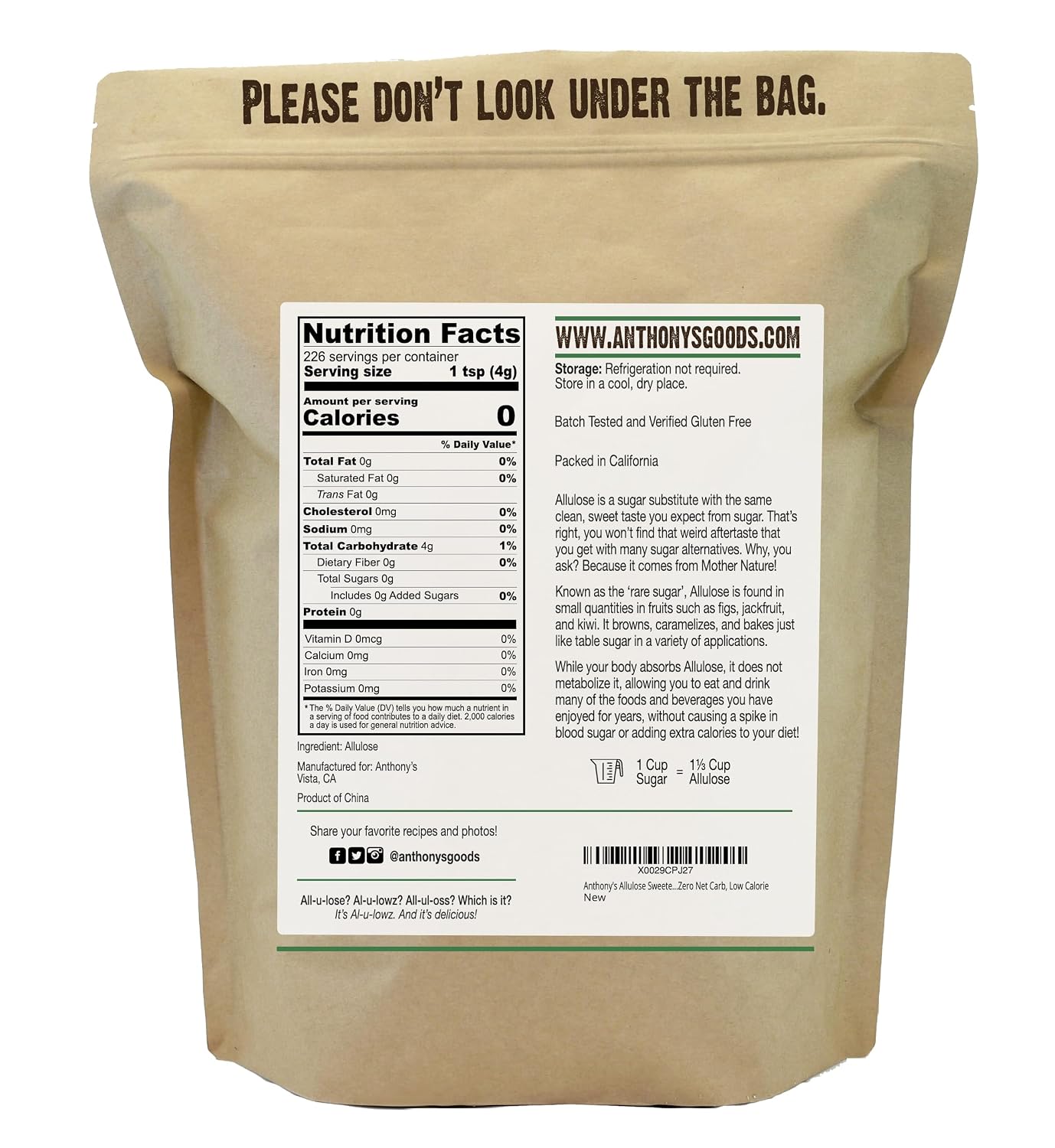
If the goal is maximum sugar-equivalence in taste (e.g., frosting, no-bake applications, beverages), 1:1 allulose performs well. Browning isn’t a factor, hygroscopicity is manageable, and the flavor profile is clean. Anthony’s Goods allulose is widely regarded as a reliable bulk option for this use case, with a fine grind that dissolves cleanly.
If the goal is functional baking with browning, structure, and shelf life, a blend typically outperforms pure allulose. Common practitioner formulations pair allulose (50–70%) with erythritol or monk fruit-erythritol blends (30–50%) to:
- Raise effective browning temperature back toward the sucrose range
- Reduce hygroscopicity
- Preserve the zero-glycemic-impact profile
Lakanto Golden’s monk fruit-erythritol blend is frequently cited by recipe developers as a compatible blend partner for allulose precisely because the erythritol component moderates browning and texture behavior. Swerve Confectioners (erythritol-based) fulfills a similar function in cake and frosting applications where allulose provides the clean sweetness and Swerve provides structure stability.
The diabetes.org guidance on non-nutritive and alternative sweeteners supports the principle that blended approaches can provide more consistent glycemic outcomes than single-sweetener formulations, which maps to what experienced formulators see on the baking side as well: blends simply behave more predictably.
If you’re in a commercial or prosumer context and batch consistency matters, the case for blending is even stronger. A single-source allulose with documented moisture content and granulation spec (Anthony’s Goods and NOW Foods both publish this information for their bulk formats) is the starting point — then the blend ratio becomes a calibrated variable you tune rather than a guess.
The Decision Rule
Here’s the “if X, then Y” framework this article is building toward:
If you’re using allulose in no-heat or cold applications (frostings, drinks, no-bake bars): use 1:1 with sucrose, full stop. No adjustment needed.
If you’re baking cookies, bars, or anything under 1 inch thick: reduce oven temperature by 25–50°F and extend time by 10–20%. Watch for visual over-browning 5–8 minutes before you’d check a sucrose recipe. Use a light-colored pan or parchment.
If you’re baking cakes, muffins, or high-moisture items: reduce by 25°F and rely on internal doneness cues (toothpick, internal temperature) over visual browning cues.
If you’re doing candy or caramel work: use a thermometer, work in 5°F increments near target temperature, and have a water bowl ready. The working window is real but compressed.
If shelf life beyond 48 hours matters: blend allulose with erythritol or a monk fruit-erythritol product at a minimum 30% erythritol ratio, or engineer your packaging for airtight moisture control.
If you’re getting bitter aftertaste: the problem is almost certainly over-browning, not the allulose itself. Drop the temperature before you drop the sweetener.
Allulose is genuinely one of the most functional natural sweeteners available for baking — it creates soft texture, holds moisture at eating time, and delivers a clean, non-cooling sweetness that erythritol alone can’t match. But it’s a precision tool, not a drop-in replacement, and the brands selling it have an interest in framing it as the latter. The temperature and blend adjustments above aren’t workarounds for a flawed ingredient — they’re the calibration that makes an excellent one perform as advertised.